Best Leaf Blower 2026: What to Check Before You Buy
Picks based on maker specs and manuals. How we review
The best leaf blower for most suburban yards is a mid-to-high CFM battery handheld that balances published air volume, weight, and neighborhood noise. Our overall pick is the EGO Power+ LB6504 for strong published CFM and MPH on a 56V platform. For large wooded properties and sustained work, start with a gas backpack such as the Husqvarna 350BT, and for small yards near an outlet, a corded WORX WG521 is a practical value path.

Emissions context: EPA nonroad engine regulations.
Top picks at a glance
| Model | Price | Best for | Power | Published CFM / MPH | Weight note |
|---|---|---|---|---|---|
| EGO Power+ LB6504 | Not published by maker Check current price | Overall | 56V battery | 650 (turbo) / 180 (tapered nozzle) | 4.77 lb without battery |
| Greenworks 80V Pro | about $195-$200 at time of writing (maker list price, Nov 2026) Check current price | Large yards | 80V battery | 730 / 170 (no condition stated) | Not published by maker |
| Milwaukee M18 FUEL | Not published by maker Check current price | Compact / light duty | 18V battery | 450 (high speed) / 120 (max) | 4.9 lb tool only |
| STIHL BGA 200 | about $555-$560 at time of writing (maker list price, Nov 2026) Check current price | Pro-grade battery | Battery (AP system) | 940 m³/h (CFM not published by maker) / 188 (max) | 7.1 lb, no onboard battery |
| Echo PB-2620 | about $325-$330 at time of writing (maker list price, Nov 2026) Check current price | Budget gas | Gas (25.4 cc) | 456 (round pipe, at nozzle) / 172 (round pipe, at nozzle) | 9.8 lb dry, with blower pipes |
| Husqvarna 350BT | about $425-$430 at time of writing (maker list price, Nov 2026) Check current price | Backpack / heavy duty | Gas (50.2 cc) | 692 in housing, 494 at round nozzle / 180 (round nozzle) | 22.5 lb backpack |
| WORX WG521 | Not published by maker Check current price | Best value corded | Corded | 800 (high speed) / 135 (high speed) | 6.6 lb machine weight |
Greenworks states no condition for its air figures, and STIHL lists air volume only as 940 m³/h, with no CFM figure.
Situation to pick
| Your situation | Start with | Why |
|---|---|---|
| Most suburban lots | EGO LB6504 | Strong published CFM on a battery platform |
| Larger lot, want more published air volume | Greenworks 80V Pro | Higher CFM class on an 80V platform |
| Quick porch and walkway jobs | Milwaukee M18 FUEL | Light weight if you already own M18 packs |
| Want pro-leaning battery build | STIHL BGA 200 | Dealer support and AP ecosystem fit |
| Rural budget gas handheld | Echo PB-2620 | Unlimited runtime when noise rules allow |
| Large wooded properties | Husqvarna 350BT | Backpack runtime and published power |
| Small yard near an outlet | WORX WG521 | Corded simplicity and unlimited runtime |
| Also shopping yard wash tools | See pressure washer guide | Same outdoor cleanup season |
| Also shopping mowing gear | See lawn mower guide | Shared battery platforms matter |
What CFM and MPH actually mean
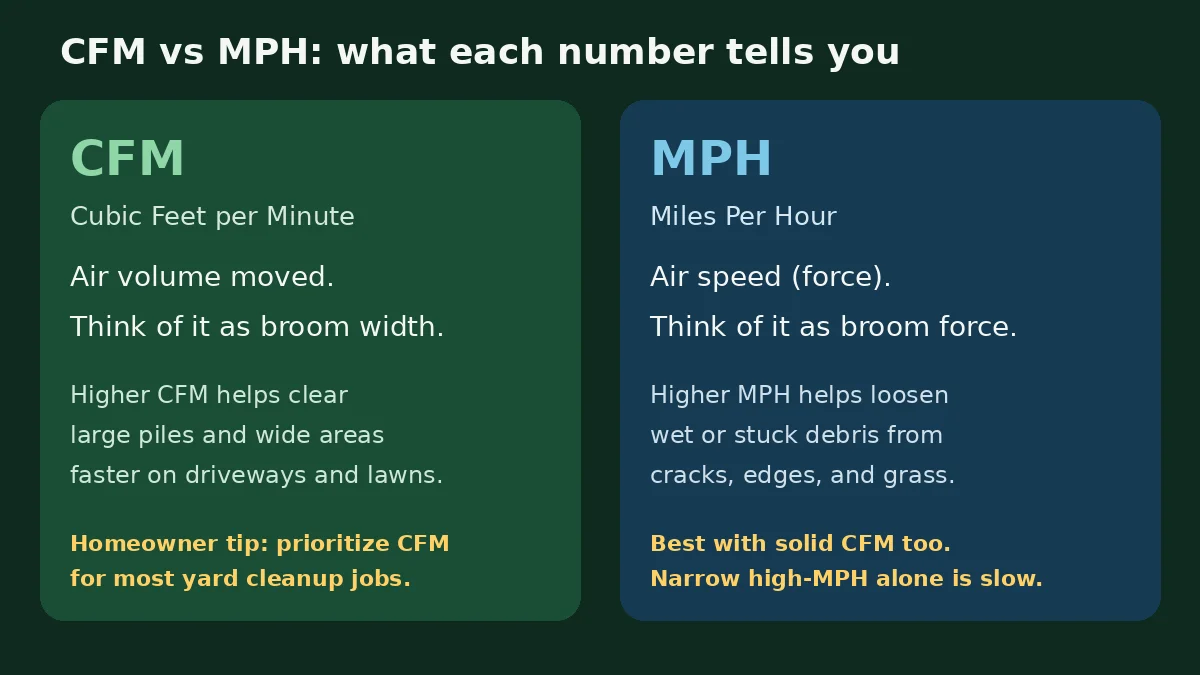
CFM (cubic feet per minute) is air volume. Higher CFM usually clears larger piles and wider surfaces faster.
MPH (miles per hour) is air speed. Higher MPH helps loosen wet or stuck debris.
For most homeowners, prioritize CFM first, then enough MPH for damp leaves. A narrow high-MPH stream alone can feel forceful but slow on big driveways.
Battery vs gas vs corded
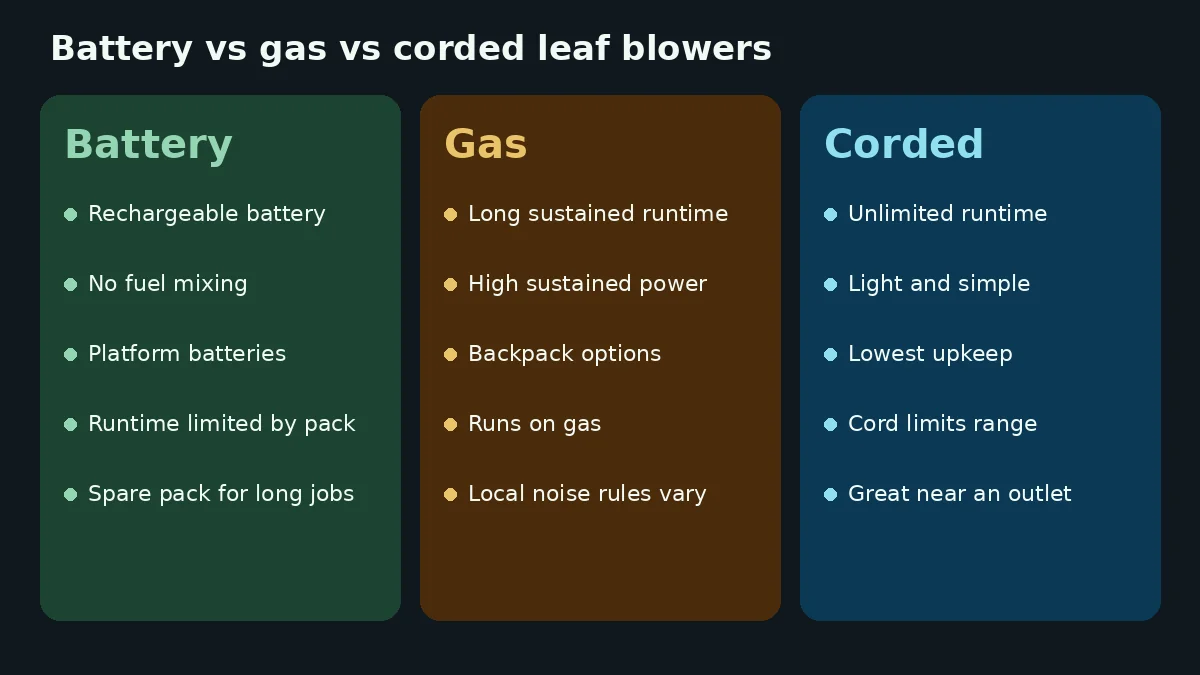
Battery models avoid fuel mixing. Runtime depends on amp-hours and throttle. Plan a second pack for long cleanups.
Gas still wins for sustained all-day work, especially backpack formats on large properties. Expect more noise, more weight, and more maintenance. Check local ordinances first.
Corded remains a strong value when you stay within outdoor extension-cord reach. Unlimited runtime, light weight, and simple upkeep trade against cord management.
Full product notes
Best Overall: EGO Power+ LB6504
OverallEGO Power+ LB6504: Check current price
The EGO LB6504 is the pick for most suburban homeowners who want strong published CFM on a battery platform. EGO lists 650 CFM in turbo mode and up to 180 MPH with the tapered nozzle on the 56V platform, with variable speed and a turbo boost control on common kits.
Quick specs: Power: 56V battery. Published air: 650 CFM (turbo) / 180 MPH (tapered nozzle). Weight: 4.77 lb without battery. Noise note: EGO lists a 64 dB noise level and does not state the measurement point. Confirm battery amp-hours and whether the kit includes a charger.
Homeowners with most suburban lots who want battery clearing and may already own EGO 56V tools.
All-day backpack volume on large wooded properties, or buyers who need the lowest corded spend near an outlet.
Runtime on turbo depends on the pack. Total weight depends on the battery you fit. Confirm exact kit contents before you buy.
Best for Large Yards: Greenworks 80V Pro
Large yardsGreenworks 80V Pro blower: Check current price
The Greenworks 80V manual lists 730 CFM and 170 MPH. The higher voltage platform is aimed at longer sustained delivery than lighter compact tools. Cruise-control style lock features appear on many kits and reduce trigger fatigue on long runs.
Quick specs: Power: 80V battery. Published air: 730 CFM / 170 MPH (no condition stated). Weight: Not published by maker.
Larger lots that want high published CFM without switching to gas.
Tiny patio jobs where a compact M18-class blower is enough, or buyers avoiding larger 80V pack cost.
Heavier than compact blowers. 80V batteries can cost more than smaller platforms. Verify bare-tool versus kit pricing.
Best Compact / Light Duty: Milwaukee M18 FUEL
CompactMilwaukee M18 FUEL blower: Check current price
The Milwaukee M18 FUEL class is built for quick jobs: porches, walkways, garage floors, and light dry debris. Milwaukee lists 450 CFM on high speed and 120 MPH maximum air speed, with a tool only weight of 4.9 lb. It is not built for heavy wet leaf loads on large properties.
Quick specs: Power: M18 battery platform. Published air: 450 CFM (high speed) / 120 MPH (max). Weight: 4.9 lb tool only. Best when you already own M18 packs.
Daily-driver tidy-ups and Milwaukee platform owners who want one-handed convenience.
Heavy wet leaf volumes on large lawns, or buyers who need backpack runtime.
Lower published CFM than premium 56V and 80V blowers. Short nozzle reach on some kits. Confirm battery not included on bare-tool SKUs.
Best Pro-Grade Battery: STIHL BGA 200
Pro batterySTIHL BGA 200: Check current price
STIHL positions the BGA 200 as a bridge between homeowner and commercial battery use. STIHL lists an air flow rate of 940 m³/h and a maximum air velocity of 188 MPH, with an adjustable tube and soft-grip handling notes. The AP battery system is proprietary, so ecosystem fit matters.
Quick specs: Power: STIHL AP battery system. Published air: 940 m³/h / 188 MPH (max). Weight: 7.1 lb, no onboard battery. Confirm dealer kit contents and battery series.
Buyers who want STIHL dealer support and already own or plan to own AP batteries.
Shoppers who want the lowest spend or open retail battery ecosystems only.
Premium pricing. Proprietary batteries. Availability may route through dealers more than big-box aisles.
Best Budget Gas: Echo PB-2620
Budget gasEcho PB-2620: Check current price
The Echo PB-2620 is a gas handheld path for buyers who want unlimited runtime without a battery platform. Echo lists 456 CFM and 172 MPH at the nozzle with the round pipe, from a 25.4 cc engine. Expect more noise than battery peers and normal two-stroke fuel care.
Quick specs: Power: gas handheld. Published air: 456 CFM / 172 MPH (round pipe, at nozzle). Weight: 9.8 lb dry, with blower pipes. Noise note: 70 dB(A) at 50 ft (15 m) per ANSI B175.2, per the manufacturer. Confirm local noise rules.
Rural or less noise-restricted properties that want fuel-based runtime at a lower tool price tier.
Quiet neighborhoods with gas blower limits, or buyers who refuse fuel mixing and seasonal engine care.
Louder than battery options. Fuel mixing and storage care required. Emissions and ordinance risk in some cities.
Best Backpack / Heavy Duty: Husqvarna 350BT
BackpackHusqvarna 350BT: Check current price
The Husqvarna 350BT is the large-property pick when published backpack power and sustained runtime matter more than battery convenience. The manufacturer lists 692 CFM air flow in the housing (494 CFM at the round nozzle) and 180 MPH with the round nozzle from a 50.2 cc engine, with a listed weight of 22.5 lb.
Quick specs: Power: gas backpack. Published air: 692 CFM in housing, 494 CFM at round nozzle / 180 MPH (round nozzle). Weight: 22.5 lb. Noise note: 94 dB(A) sound pressure at the operator’s ear, 104 dB(A) guaranteed sound power, per the manufacturer.
Large wooded properties, heavy leaf seasons, and long cleanups where you would rather refuel than swap batteries.
Small yards, early-morning suburban use, or anyone who wants zero fuel maintenance.
Heavy and loud. Seasonal gas maintenance. Overkill for patio-only cleanup.
Best Value Corded: WORX WG521
ValueWORX WG521 corded blower: Check current price
Corded blowers still earn a place when outlet access is reliable. WORX lists up to 800 CFM on high speed through a corded motor, with a machine weight of 6.6 lb. Pair it with a rated outdoor extension cord and keep the cord behind your work path.
Quick specs: Power: corded electric. Published air: 800 CFM / 135 MPH (high speed). Weight: 6.6 lb machine weight. Unlimited runtime while plugged in.
Small to mid yards within cord reach that want low upkeep and a lower spend.
Wrap-around lots far from outlets, or buyers who need backpack gas volume.
Cord management limits range. Lower MPH than some premium battery kits. Not ideal for distant fence lines.
How to choose by yard size
| Yard / use | Start with |
|---|---|
| Small yards and patios near an outlet | Corded WORX WG521 or compact Milwaukee M18 FUEL |
| Most suburban lots | EGO LB6504 or STIHL BGA 200 |
| Larger lots | Greenworks 80V Pro or gas handheld |
| Large wooded properties with heavy hardwoods | Husqvarna 350BT backpack |
Also match your existing battery platform. An EGO mower battery often makes the LB6504 the path of least resistance. The same logic applies to Milwaukee M18 and STIHL AP owners.
Wet leaves need more force than dry ones. If fall rains are common where you live, lean toward higher published CFM.
Maintenance notes
Battery blowers need little routine care beyond clear intake vents and sensible battery storage above hard freeze. Gas blowers need fresh fuel mix practices, air filter checks, and spark plug attention on a seasonal cadence. Storage habits overlap with other outdoor tools. See the spring garden prep checklist and winterize a hose reel for related seasonal habits.
Related reading
- Best pressure washer for home use
- Best lawn mower
- Best garden hose nozzle
- Beginners guide to starting a garden
- Best wheelbarrow
Our picks
Best overall: EGO Power+ LB6504. Check price on Amazon
Best for large properties: Husqvarna 350BT. Check price on Amazon
Best value corded: WORX WG521. Check price on Amazon
Match the tool to your yard size, noise rules, and battery platform. Confirm current retailer prices before you buy.
FAQ
What CFM do I need for my yard size?
Use CFM as a rough sizing guide, not a guarantee. Small patios and walkways need the least air volume, and larger suburban lots benefit from more. Big lots, heavy wet loads, or many mature trees usually call for the highest CFM handhelds or a backpack format.
Is CFM or MPH more important in a leaf blower?
CFM measures air volume and usually matters more for clearing large piles and wide surfaces. MPH measures air speed and helps loosen wet or stuck debris in cracks and grass. For most homeowners, prioritize solid CFM first, then look for enough MPH to move damp leaves. A high-MPH, low-CFM stream can feel forceful but slow on big areas.
Are battery leaf blowers as powerful as gas in 2026?
On published air volume, some battery handhelds now list figures in the same range as gas handhelds. Makers measure CFM under their own conditions, so compare figures within one brand's lineup. Battery models skip fuel mixing. A gas backpack such as the Husqvarna 350BT runs as long as you have fuel, which suits long sessions on large properties. Match the format to your yard and local noise rules.
How long do leaf blower batteries last?
Published runtime varies by battery amp-hours and throttle setting. EGO lists about 30 minutes on high speed, 15 minutes in boost mode, and 200 minutes on low speed for its LB6504 blower with the included 56V 5.0Ah battery. A second battery is the practical fix for larger cleanups. Store packs out of hard freeze when possible and keep intake vents clear of debris.
Can I use a leaf blower to clear gutters?
Many brands sell a separate gutter kit that angles airflow into the trough. Dry leaves clear more easily than wet packed debris. Always use eye protection, because debris can bounce back. Confirm kit compatibility for your exact model before you buy an attachment.
Are gas leaf blowers restricted or banned in some places?
Yes. Some cities and states limit or ban gas-powered leaf blowers for noise or emissions reasons, and rules change over time. Check your local ordinance before you buy gas. Battery models are the safer long-term bet in noise-sensitive neighborhoods. The EPA publishes nonroad engine emission rules for outdoor power equipment.
Should I buy a blower-vac combo or a dedicated blower?
Dedicated blowers are usually lighter and stronger for pure clearing. Combo units add vacuum and mulch convenience but can feel heavier in vac mode and the impeller can be more vulnerable to rocks. Choose a combo for small yards where you want to mulch into beds. Choose dedicated blowing when speed on large surfaces matters most.
EGO LB6504 vs Husqvarna 350BT: which should I buy?
Start with the EGO LB6504 for most suburban lots when you want battery power and platform compatibility. Choose the Husqvarna 350BT when you need backpack runtime on large wooded properties or commercial-style leaf volume. Confirm current prices, battery kits, and local noise rules before you purchase.